20th October 2026

Privacy Pools v2 is live
Privacy Pools v2 is live today on Ethereum mainnet, Arbitrum, Base, OP Mainnet, BNB Chain, Robinhood Chain, and Citrea. With v2 you can make transfers, earn yield, swap tokens, withdraw to a fresh wallet, create payment requests, and more.
Try it at privacypools.com.
What’s new in v2
Privacy Pools v1 launched on Ethereum mainnet in March 2025, based on a 2023 research paper co-authored by Vitalik Buterin. It has since taken in over $26M in deposits and showed that privacy and compliance can work together. With v1 you could deposit funds and later withdraw them to a new address, with no onchain link to the deposit. But funds could only go in and come out, which made behavioural tracking easier and limited what types of private activity were possible.
v2 lets funds move inside a shielded pool, where outside observers can’t see what happens. Here’s what this unlocks:
Send privately. Transfers inside the pool don’t reveal the sender, the recipient, or the amount. Payments no longer mean leaving the pool.
Request payments privately. Send someone a link and get paid, without either of you revealing your address to the other.
Earn while you stay private. Deposits can earn yield through Aave. Your balance grows automatically while it’s shielded, with nothing to claim and no yield payments for anyone to watch.
Swap privately. Deposit from nearly any token in your wallet, swap between supported assets, and withdraw to the asset and chain you choose.
No deposit fees on yield pools. The protocol takes a share of the yield instead, so privacy doesn’t need to cost a percentage of your net worth.
Keep your wallet. Any EVM address can send and receive. There’s no new seed phrase, no special wallet, and nothing extra to back up.
The rest of Privacy Pools stays the same. It’s non-custodial, doesn’t require KYC, and there are no global viewing keys or backdoors. Only funds approved by the Association Set Provider operated by 0xbow can transact privately, and approval can be revoked so the pool doesn’t become tainted over time.
Supported chains and assets
Privacy Pools v2 is live on Ethereum mainnet, Arbitrum, Base, OP Mainnet, BNB Chain, Robinhood Chain, and Citrea. Support for yield and swaps depends on the chain and asset:
Network | Assets | Yield through Aave | Swaps |
|---|---|---|---|
Ethereum | ETH, USDC, USDT | ETH, USDC, USDT | Yes |
Arbitrum | ETH, USDC, USDT | ETH, USDC, USDT | Yes |
OP Mainnet | ETH, USDC, USDT | ETH, USDC, USDT | Yes |
Base | ETH, USDC, USDT | ETH, USDC | Yes |
BNB Chain | BNB, USDT, U, FDUSD | USDT | Yes |
Robinhood Chain | ETH, USDG | No | No |
Citrea | cBTC | No | No |
How it works
Core concepts
Notes. Your shielded balance is a set of notes, each recording an owner, an asset, and an amount. Only a commitment to each note, a Poseidon hash, goes onchain, so no one can read what’s inside.
Zero-knowledge proofs. Every private action carries a proof that your notes exist and that no value was created or destroyed, without revealing which notes they are. Each spent note publishes a nullifier, so it can never be spent twice.
Labels and the ASP. Every deposit gets a private label that all notes from it inherit, so funds from different deposits never mix. The Association Set Provider (ASP) screens deposits and publishes the set of approved labels onchain, and every private spend must prove its labels are in it. Anyone you pay can prove compliance without tracing the funds back to your deposit.
Keys. Signing a message with your wallet derives your Privacy Pools keys, which you register once in an onchain keystore. There’s nothing new to back up, and you can rotate your spending key without moving any funds.
Relayers. A relayer submits your private transactions and pays the gas so your address is not connected to the transaction onchain. It takes its fee in the asset you’re moving.
Shield
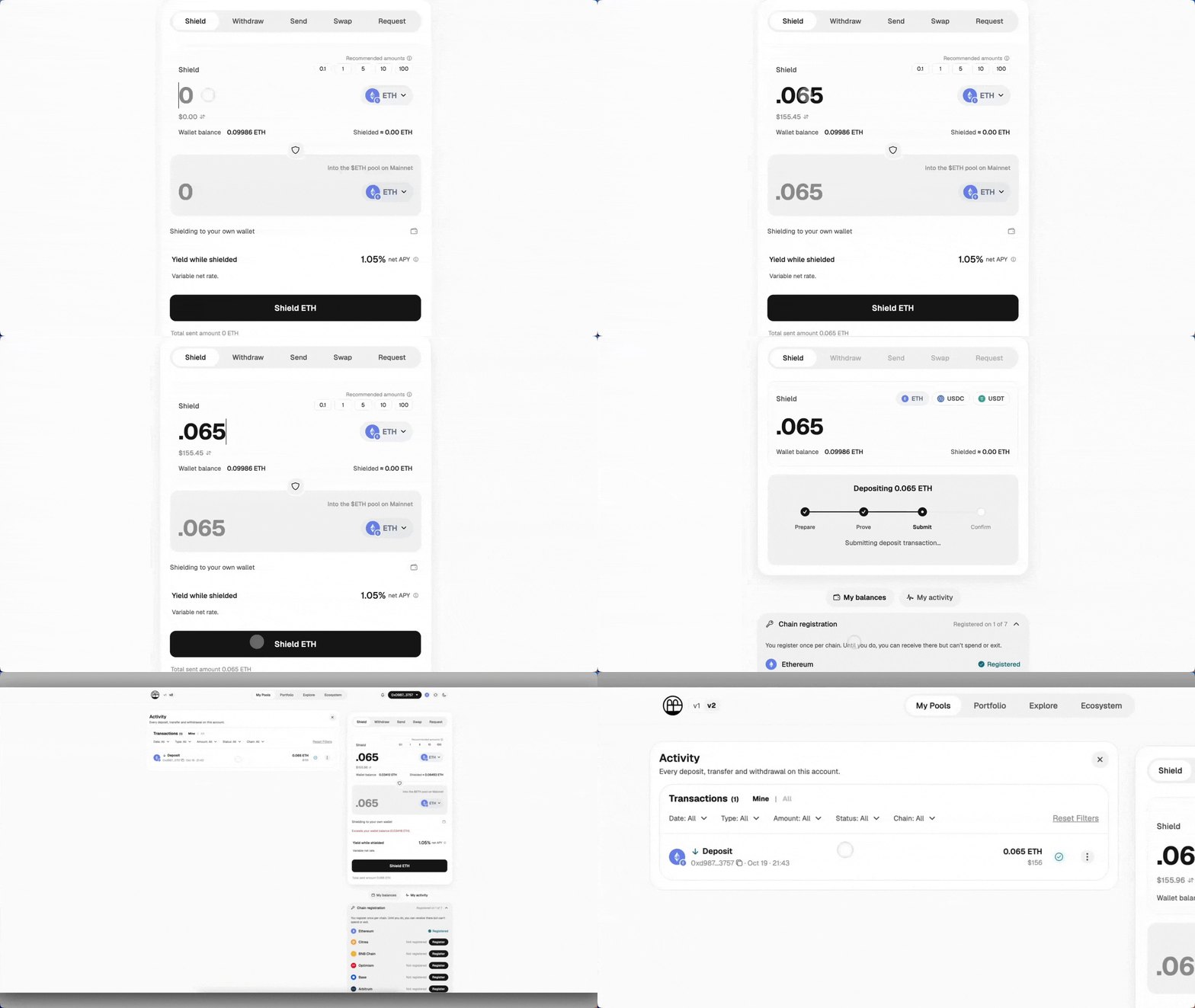
Shielding moves funds from your public wallet into the pool. You can shield a supported asset directly or, on chains with swaps, pay with nearly any other token via swap. The ASP then reviews the deposit and once it’s approved, the funds can be used privately.
Send
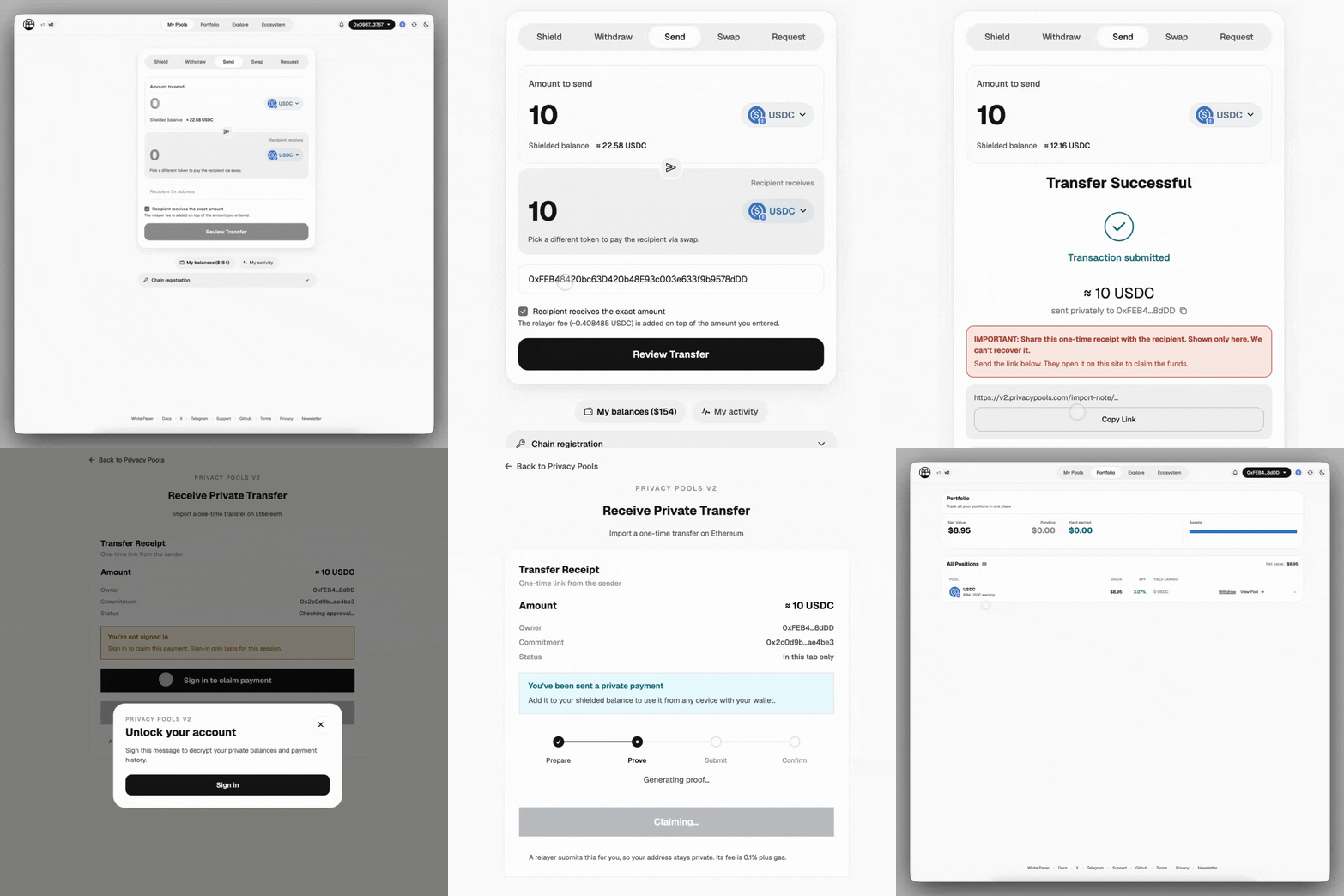
Send shielded funds to any EVM address. The transfer happens inside the pool, so observers see only that a valid transaction took place, not the sender, the recipient, or the amount. If the recipient hasn’t used Privacy Pools before, you get a claim link to pass on, and they register once to claim.
Request
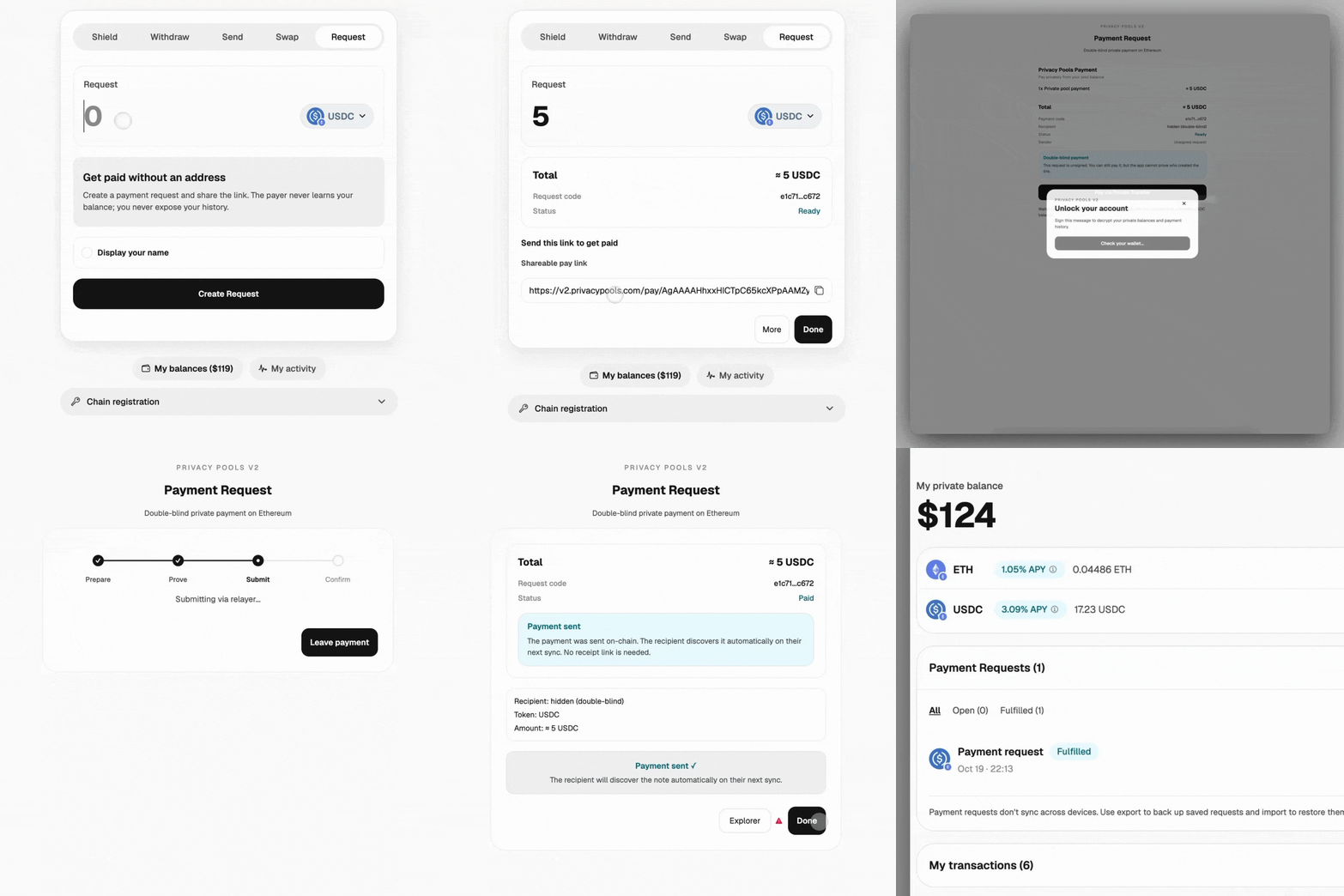
Create a payment request and share the link. Instead of your address, it carries one-time note address hashes built from your address and fresh secrets that stay on your device, so the payer can pay you without learning who you are. They can pay from a shielded balance or directly from a wallet, and the request expires after a set time.
Swap
Swap in-pool between assets, same chain or across chains, with routes from LI.FI. You can keep the result or send it privately to someone else. Swaps work on every chain marked in the Supported chains and assets section.

Earn yield
Where yield is offered, eligible assets go into Aave v3 automatically when you shield them. Your note holds a fixed number of ERC-4626 vault shares (e.g. ppUSDC for USDC) and each share gains value as interest accrues, so your balance grows with no yield events onchain. When you unshield yield-bearing assets, the accrued yield is automatically added.
Unshield
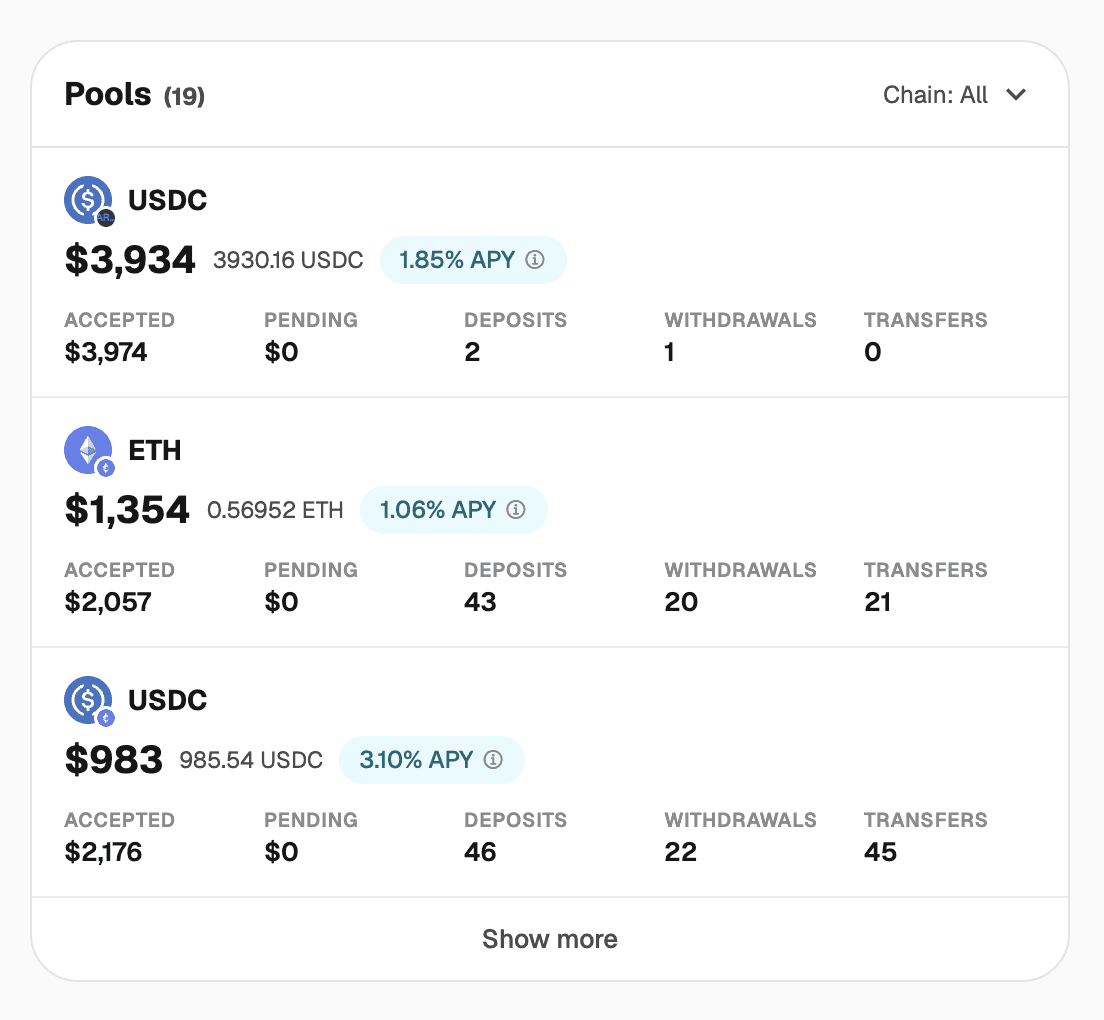
Unshielding moves funds from the pool back to a public wallet. You can unshield to any address and it’s recommended to use fresh addresses. On chains with swaps, you can also receive a different asset or receive on another chain.

Exit at any time
If the ASP declines your deposit or for any other reason, you can always ragequit: a public exit to your wallet that needs no ASP permission. You pay the gas and give up privacy for that note, but your funds are never frozen.

For developers
Onchain privacy has often meant standalone apps that users had to seek out. v2 is built to be embedded instead: a privacy layer that wallets, payment apps, and financial products can add, so privacy reaches people where they already manage their money.
Private transfers, payment requests, yield, and swaps are all available through the Privacy Pools SDK. Because v2 works with any EVM address, users don’t create or back up new keys: their Privacy Pools keys are derived from a wallet signature. Screening is built into the protocol, and you never take custody of user funds.
A Rust SDK for web, mobile, and browser extensions will be released in Q4, and support for multisigs and hardware wallets is currently in development. The Ethereum Foundation has also included Privacy Pools in its Kohaku initiative to bring privacy to the wallet layer, with Ambire among the first adopters.
If you’re building wallets, payments, payroll, cards, OTC desks, or DeFi and your users need privacy, start with the docs and get in touch for support.
Technical partners
v2 is the combined effort of several teams. Wonderland built the smart contracts, zero-knowledge circuits, SDK, and trusted setup ceremony. Fat Solutions built the relayer and the infrastructure behind swaps and yield. Swaps route through LI.FI and yield is built on Aave.
Thank you to everyone who helped build v2, and to the 500 people who contributed to the v2 trusted setup ceremony.
Get started
Privacy Pools v2 is live at privacypools.com. Make a deposit, send a transfer, create a payment request, swap tokens, or earn yield.
v1 remains available at v1.privacypools.com. Your funds are safe, you can move them to v2 when you’re ready.